.png)
Balenciaga: The Ghesquière Years.

Balenciaga is something of an anomaly. Whilst Dior has long relied upon floral symbolism, and tweed continues to be synonymous with Chanel, the codes of Balenciaga remain largely
undefined. Not only is the brand virtually unrecognisable from that founded by Cristóbal Balenciaga in Paris in the late 1930s, but the eras that followed his death diverge so significantly from one another that house identifiers are all but nonexistent.
The fabled house was opened with the intent of creating couture, and with Coco Chanel herself declaring Balenciaga as “a couturier in the truest sense of the word”, it’s clear his work spoke for itself. Yet today, we associate the brand largely with streetwear and unconventional sneakers following Demna’s reign. Innovation and creativity may have prevailed throughout its history, yet the house today is a far cry from the beacon of elegance established by Balenciaga. Whilst critics often hold Demna (who exited the brand in 2025 in favour of Gucci) at fault for what some consider
a fall from grace, the roots of the identity crisis stem from Balenciaga’s revival in the late 1980s.
Upon closing his atelier in 1968 and his passing in 1972, Balenciaga hoped for his name to die
with him, and for some time, it did. The house lay dormant for almost two decades, until being
acquired by Groupe Jacques Bogart (a French fragrance group) in 1986. The following year, they
set to work resurrecting the brand, with one key difference; instead of haute couture, they would
focus on ready-to-wear, something the founder famously refused to engage with. Over the next ten
years, two designers (Michael Goma until 1992, and Josephus Thimister until 1997) would be
handed the impossible task of taking this once glorious couture house into a new era. They failed
to succeed.
Enter Nicholas Ghesquière.
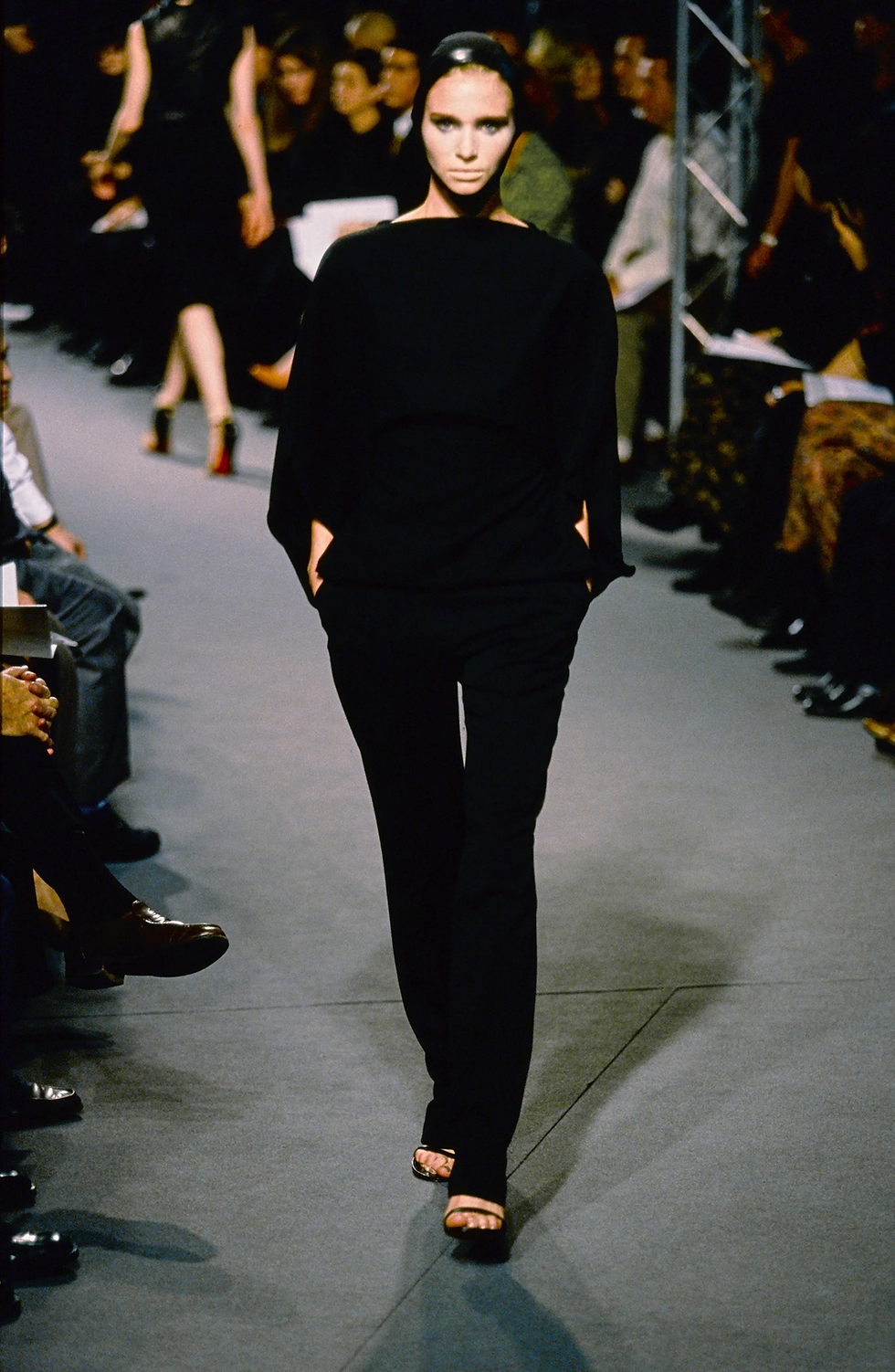
Now widely known as the creative director of womenswear at Louis Vuitton (as he has been since 2013), he was once a young prodigy who placed Balenciaga firmly back on the Parisian fashion scene. At the mere age of 26, he was thrust into the spotlight as a shock replacement for the coveted role, and with all cards stacked against him, he thrived. From the onset, it was clear that whilst drawing inspiration from the founder, Ghesquière was carving out his own aesthetic. It was his debut collection, Spring 1998 (which he produced in just four short months), that reignited
interest in the brand and formed the path for a transformative fifteen years at the helm. He crafted a hybrid design language consisting of classic Balenciaga and contemporary nineties minimalists (the likes of Helmut Lang and Jil Sander), dusting off the forgotten house and garnering the attention of the press. 51 girls draped in black jersey looks (with the exception of the occasional white contrast) took to the runway, each complete with a leather chin-strapped headband. Ghesquière had no faith in the venue, nor did he have the opportunity to select his own models (although a then unknown Gisele Bündchen was amongst them), thus, it was down to the clothes to speak for themselves, and that they did.

If you were to select one symbol which encapsulates his success at the brand, it would
undoubtedly be the revered Balenciaga City Bag. Although, ironically, this piece of Y2K
iconography almost failed to make it to the production line altogether. In 2001, he was tasked with creating an ‘it’ bag to compete with the likes of the Louis Vuitton Speedy and Fendi Baguette. What Ghesquière came back to the drawing board with something that was not what the higher-ups had in mind. It was slouchy and edgy; practically poles apart from the tasteful pieces other brands were putting forward. That right there could have easily been the end of it, however a handful of models (Kate Moss included) caught sight of the samples and took an immediate liking. With no other use for them, Ghesquière gifted the unwanted bags to the models, which would turn out to be their saving grace. Of course, this was prior to the days of social media, but the best way to describe the City Bag at the time was viral. Photographed on the arm of the it-girls of the time, the public yearned for a piece of the pie, and thus, the famous handbag was born.
Throughout his tenure, Ghesquière flourished. With competitors scrabbling to acquire his talents, he remained loyal to Balenciaga and developed a visual identity that continues to be relevant today. Season upon season, he pushed the boundaries and was met with delight across the board, with perhaps the pinnacle coming in the form of Spring 2006. Inspired by the archives, he re- conceptualised Balenciaga for the modern woman with 3-D style skirts and timeless patterns, pulling together one of the most memorable collections to date.
Yet, as with all great things, it eventually reached a rather abrupt end. After announcing his departure in November 2012, it was later revealed that he felt entirely drained, and it was as if his design identity had been absorbed by the brand; his work was no longer recognised as his, but as Balenciaga’s. Thus, with that, the curtains closed on one of the most generational runs the industry has witnessed.
Ultimately, though, did Ghesquière return the house to its glory days beneath the founder, or was he simply another chapter in the book? Whilst it’s true that he certainly used historical references, placing some identity back into the brand, so did Demna (after all, he was the one who returned the house to couture in 2021), and Pierpaolo Piccioli is now following suit. It feels more accurate to suggest that throughout his stint, he took ownership of the brand and made it his own, something that his predecessors equally executed. Given that today, the Triple S and Speed Sock Sneakers are what the general public associates most with Balenciaga, it feels that Ghesquière’s impact has slipped through the cracks somewhat.
Perhaps that is part of the charm surrounding the House of Balenciaga. Each era is so distinctive,
allowing the creative directors to embrace their own artistry and flair. In an industry in which brands
are bound by aesthetic, perhaps an outlier isn’t a curse; it’s more of a blessing.
Comments