.png)
Paris Couture Week: The contradiction of couture.
Decadence. If you were to describe the most recent Paris Haute Couture week in a singular word,
it would most certainly be that. Unsurprising, no? After all, this is no regular fashion week; taking
place bi-annually, in January and July, it represents the pinnacle of craftsmanship and artistry. With
only the most acclaimed of houses (think Chanel, Dior and Schiaparelli) holding slots on the
calendar, an air of exclusivity underpins the entire week.

So, given that, you would expect the utmost opulence. Though across these particular five days, as the most important faces in the industry gathered to (ironically) observe the Fall/Winter collections, they were met by one of the greatest heatwaves Western Europe has ever experienced; a blazing reminder that climate change is a very serious problem.
One of the great contributors to climate change? The fashion world.
So amongst the grandeur, there was an underlying darker tone. The sweltering heat (a recurring grievance throughout the course of the week) was partially a result of the industry attendees that had gathered to celebrate.
Yet, as with many walks of life, a little frivolity keeps some joy alive, and what was sent down the runway during couture week certainly invoked joy. Matthieu Blazy reinterpreted the life of Gabrielle Chanel through fairytale references, Jonathan Anderson paid homage to American sculptor Lynda
Benglis, and Pierpaolo Piccioli unveiled his first couture collection for Balenciaga.
Although it was Daniel Roseberry at Schiaparelli that opened the week, he set the bar
irrefutably high. We’ve grown to anticipate magic from Roseberry, some even regarding him as the
leading couturier in the French capital. It would be a disservice to describe his past work as predictable, though it’s completely valid to note that there are general codes we’ve come to expect;
gold embellishments, body-moulded pieces and neutral tones, to name but a few. For FW26, he turned traditional expectations on their head, and offered up a whole new, modernistic take on
the house. The Elsa Schiaparelli-approved surrealism continued, but this time was reimagined
through a futuristic lens.

Whilst Roseberry embraced modernity, another legacy house was celebrating the past; Jonathan Anderson at Dior. Beneath a leafy canopy in the gardens of Musèe Rodin, the Northern Irish designer reinterpreted the iconic Bar Jacket; almost 80 years on since it was created by Christian Dior. Taking the original concept, Anderson opted to add a looser feel to the typically buttoned-up silhouette, drawing inspiration from Benglis, whose work often blended different mediums.
Meanwhile at Chanel, Blazy (albeit less directly) paid homage to the maison’s founder. His time at the house could be described as a fairytale, with ‘Blazymania’ (as dubbed by the media) taking consumers by storm as his debut ready-to-wear collection hit stores earlier this year. Therefore, it seemed all the more fitting that he chose fairytales as the central theme for his second couture
collection, following the discovery of an antique volume of stories kept by Gabrielle Chanel in her apartment on Rue Cambon. It was ‘Jack and the Beanstalk’ that particularly caught the Belgian designer's eye; a story which celebrates someone from humble beginnings working their way to the gold; much like Chanel herself did.
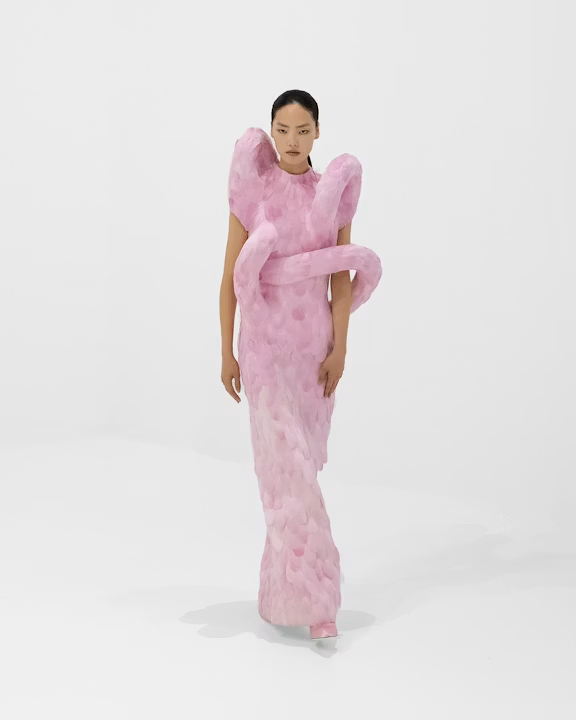
It wasn’t just the typical big names that made a splash; Piccoli offered up his first take on Balenciaga couture (after Demna brought it back to the house in 2021), and Duran Lantink of Jean
Paul Gaultier also made his couture debut. Piccoli embodied the idealistic version of this protected
craft, sending looks down the runway that could never be mistaken for ready-to-wear with
unconventional silhouettes and an exaggerated use of feathers. Lantik (who hasn’t had the easiest
of runs since joining the house last year), largely followed a similar formula, with surrealist shapes
and a 3D scanned torso corset on the body of Leon Dame.
Is it fair to describe one of the most important weeks in the industry as tone deaf? Perhaps.
Though ultimately, is there ever truly a time in which fashion doesn’t seem slightly excessive?
Couture isn’t targeted to the masses, and in many ways, it’s one of the most sustainable forms of fashion. The term ‘Haute Couture’ is protected by the French government for a reason; it celebrates only the most skilled of craftsmen, and is a true testament to what humans can achieve
in this industry.
Expensive? Absolutely. Excessive? Without a doubt. Though a phrase that seems appropriate to return to is that you cannot spell ‘Earth’ without ‘Art’. And Haute Couture is art in every sense of the word. Perhaps if we, as consumers, appreciated our clothes in the way that couture clients do, didn’t give in to fast fashion, and shopped that bit more intentionally, the industry wouldn’t be in the shape it is now.
Comments